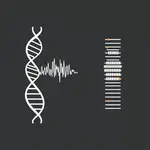
You never actually read a genome. A sequencer hands you a noisy electrical trace or billions of short, error-prone reads, and an algorithm infers the DNA underneath. Increasingly that algorithm is a neural network. DeepVariant reframed variant calling as image recognition — a CNN reading ‘images of read pileups’ — and ‘outperforms existing state-of-the-art tools’ while generalizing across species. Chiron went a step upstream, the ‘first deep learning model to achieve end-to-end basecalling,’ turning raw nanopore signal straight into sequence. Clairvoyante called variants from single-molecule reads despite a ‘~5-15%’ error rate, surfacing 3,135 variants Illumina missed. PEPPER-Margin-DeepVariant pushed long reads into ‘segmental duplications and low-mappability regions where short-read-based genotyping fails,’ and DeepConsensus used a transformer to cut read errors ‘42%.’ The referee is a blind community benchmark — precisionFDA Truth Challenge V2 on Genome in a Bottle truth sets — where ‘machine learning approaches, combining multiple sequencing technologies performed particularly well.’ Open, callable, benchmarked: the foundation every omics story stands on.