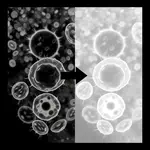
Every photon a microscope collects can bleach a dye or kill a living cell, so the deepest tradeoff in imaging is signal versus survival. Deep learning quietly rewrote it. CARE restores usable images from 60-fold fewer photons; Noise2Void denoises from single noisy images with no clean targets at all; Deep-STORM and the Ozcan lab’s cross-modality GAN push past the diffraction limit — confocal to STED-matched resolution — with no PSF model; and DFCAN reaches SIM-quality detail over a tenfold longer window of live-cell imaging. It’s the least glamorous branch of AI-for-microscopy and maybe the most enabling: gentler light means longer movies, which is what autonomous, self-driving imaging needs. But restoration carries a sharp warning — a model can infer ‘unsubstantiated image details,’ inventing structure that was never there. That makes open, callable, validatable restoration models — the AI4Life / BioImage Model Zoo ethos — not a nicety but a safeguard, and the prove-it discipline non-negotiable.