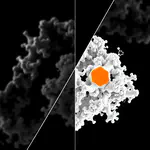
A cryo-EM dataset isn’t one picture of a protein — it’s millions of noisy 2D snapshots, each a different molecule flash-frozen mid-wiggle in a slightly different shape. For decades the job was to average them into a single sharp structure, which meant averaging the motion away. The AI turn flips that: treat the heterogeneity as the signal. cryoDRGN used neural networks to ‘directly reconstruct continuous distributions of 3D density maps,’ even ’large-scale continuous motions of a spliceosome complex.’ 3DFlex modeled the motion itself as a physical deformation; DynaMight (open-source, in RELION-5) learns per-particle deformations — while candidly warning that atom-model priors ‘may lead to important artifacts due to model bias.’ And CryoBench names the reckoning underneath it all: without standardized ground truth, how do you know a recovered motion is real and not the algorithm’s imagination? It’s the experimental twin of the predicted-motion story we told on Aug 11 — two roads to the same conformational landscape a virtual cell will have to get right.